Why Average Fleet Efficiency Matters for Bitcoin Miners
Understanding “Average Fleet Efficiency”
Average fleet efficiency, measured in joules per terahash (J/TH), reflects how much energy is required for a mining fleet to produce a given unit of computational work. In simple terms, the lower the J/TH, the less electricity miners consume to generate the same hash rate, and the lower the cost required to produce that computational power. This metric aggregates the profitability of all active machines in a mining company’s operations and provides a benchmark for competitiveness.
Think of it like an airline running a fleet of planes. If each plane carries the same number of passengers, but some are fuel-hungry while others are fuel-efficient, the airline’s average fleet efficiency ultimately depends on the balance between the two. A modern fleet that uses less fuel to fly the same distance will always enjoy lower operating costs and better margins, even if ticket prices don’t change. Mining works in the same way: efficient machines burn less electricity to produce the same hash rate.
Or imagine a delivery company. A driver with a truck that gets twice the mileage per gallon can cover the same route at a fraction of the cost compared to an older vehicle. Across hundreds or thousands of trucks, the savings compound into millions. For miners, improving fleet efficiency has the same multiplying effect—it’s not about a single machine, but the collective performance of thousands of units running 24/7.
Why Improving Efficiency Is Critical
Electricity remains the largest cost for miners, typically representing 60–70% of total expenses depending on the region. Other major costs—such as operations, maintenance, and administrative overhead—also matter, but none expand as directly and linearly with hashrate as power costs do. Improving fleet efficiency not only reduces immediate energy bills but also:
Strengthens risk resilience: A lower energy consumption per terahash translates into a lower shutdown price, meaning that when Bitcoin prices fall or network difficulty rises, more efficient fleets can remain profitable for longer.
Extends fleet lifetime: Efficient hardware can remain in operation at higher difficulty and energy price thresholds, delaying the need for costly upgrades.
Improves capital efficiency: Lower OPEX frees up cash flow for reinvestment or debt servicing.
Cost Structure Comparison: How Efficiency Reshapes Financial Balance
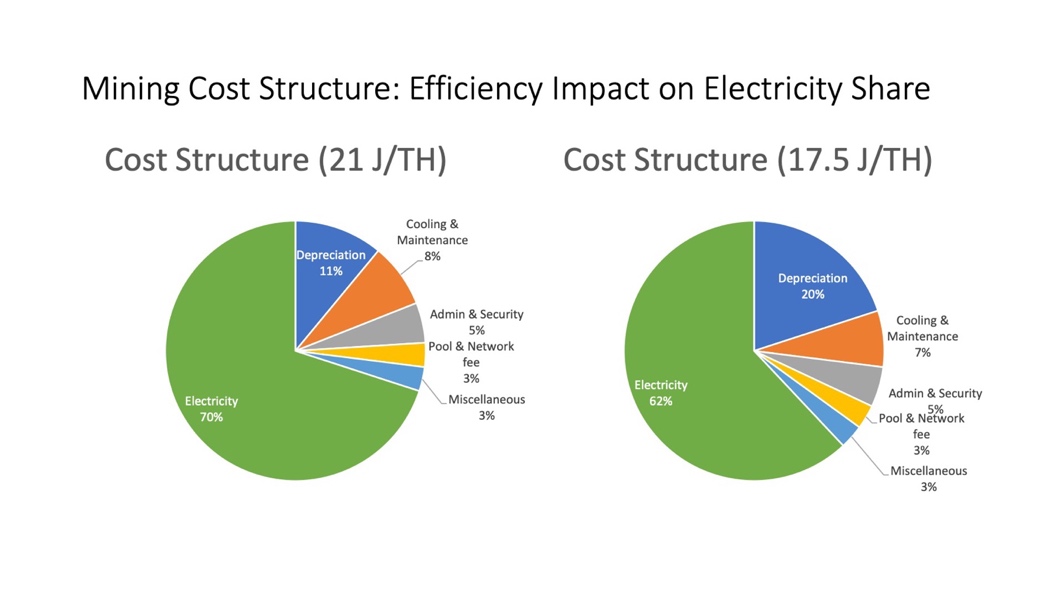
A simple cost structure comparison makes the point clear. For a fleet operating at 21 J/TH, electricity, cooling, and maintenance together can absorb 70–80% of total operating costs, while depreciation accounts for around 11%. When efficiency improves to 17.5 J/TH, the combined hosting share falls to roughly 60–70%, but depreciation rises to about 20%, reflecting the capital intensity of newer-generation hardware.
Although the composition shifts, the trade-off is favorable: higher efficiency mitigates exposure to energy price volatility and enhances operational stability. A fleet less dominated by power costs is more resilient to electricity price shocks, better able to withstand difficulty increases, and ultimately more sustainable through Bitcoin’s market cycles. In essence, efficiency transforms a miner’s cost base from fragile to resilient, and profitability from cyclical to enduring.
Quantifying the Gap: 17.5 J/TH vs 21 J/TH
To illustrate the real-world impact, let’s compare two fleet scenarios at 1 EH/s scale:
| 17.5 J/TH | 21.0 J/TH | Δ (21-17.5) J/TH |
Energy Consumption (For 1 EH/s) | 17.5 MW | 21.0MW | 3.5MW |
Cost of Energy per Hour (if cost =$0.03/kWh ) | $525 | $630 | $105 |
Cost of Energy per year (if cost =$0.03/kWh ) | $4.6M | $5.5M | $0.9M |
Cost of Energy per hour (if cost =$0.06/kWh ) | $1050 | $1260 | $210 |
Cost of Energy per year (if cost =$0.06/kWh ) | $9.2M | 11.0M | $1.8M |
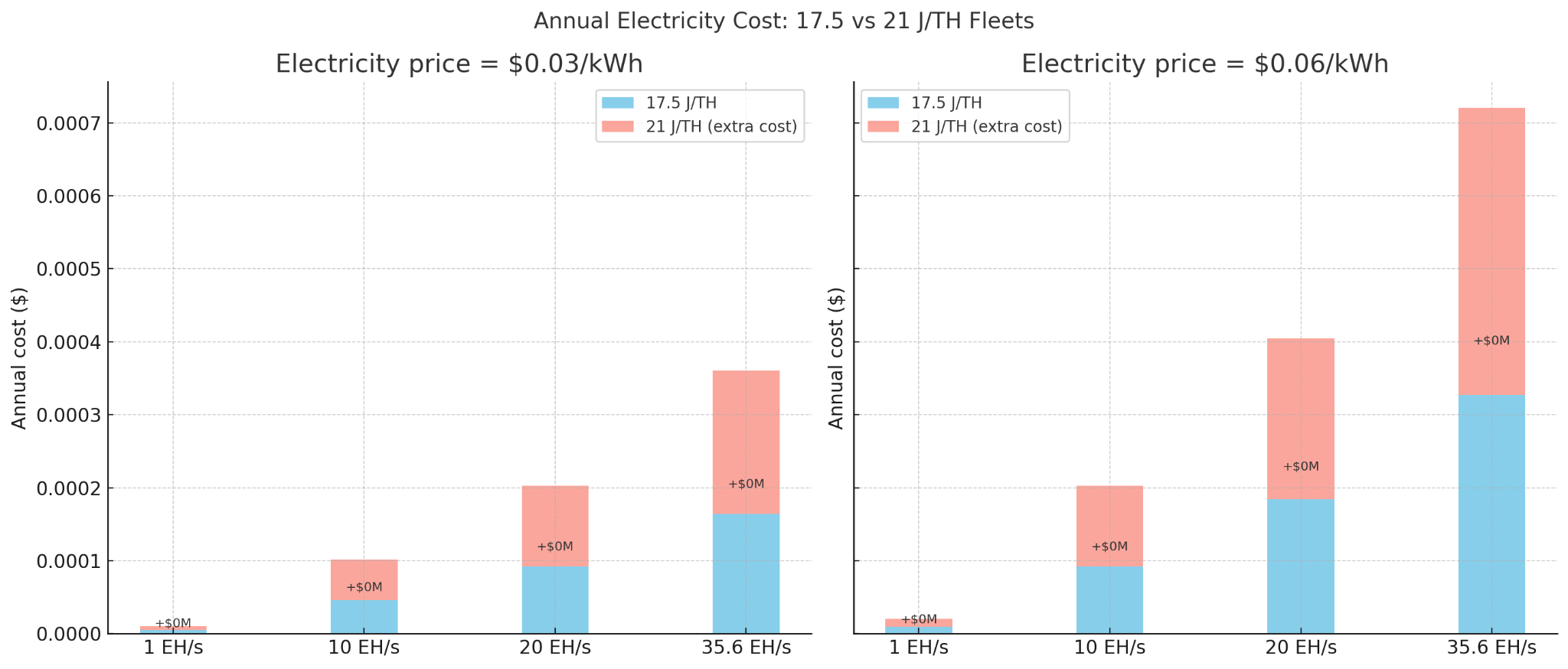
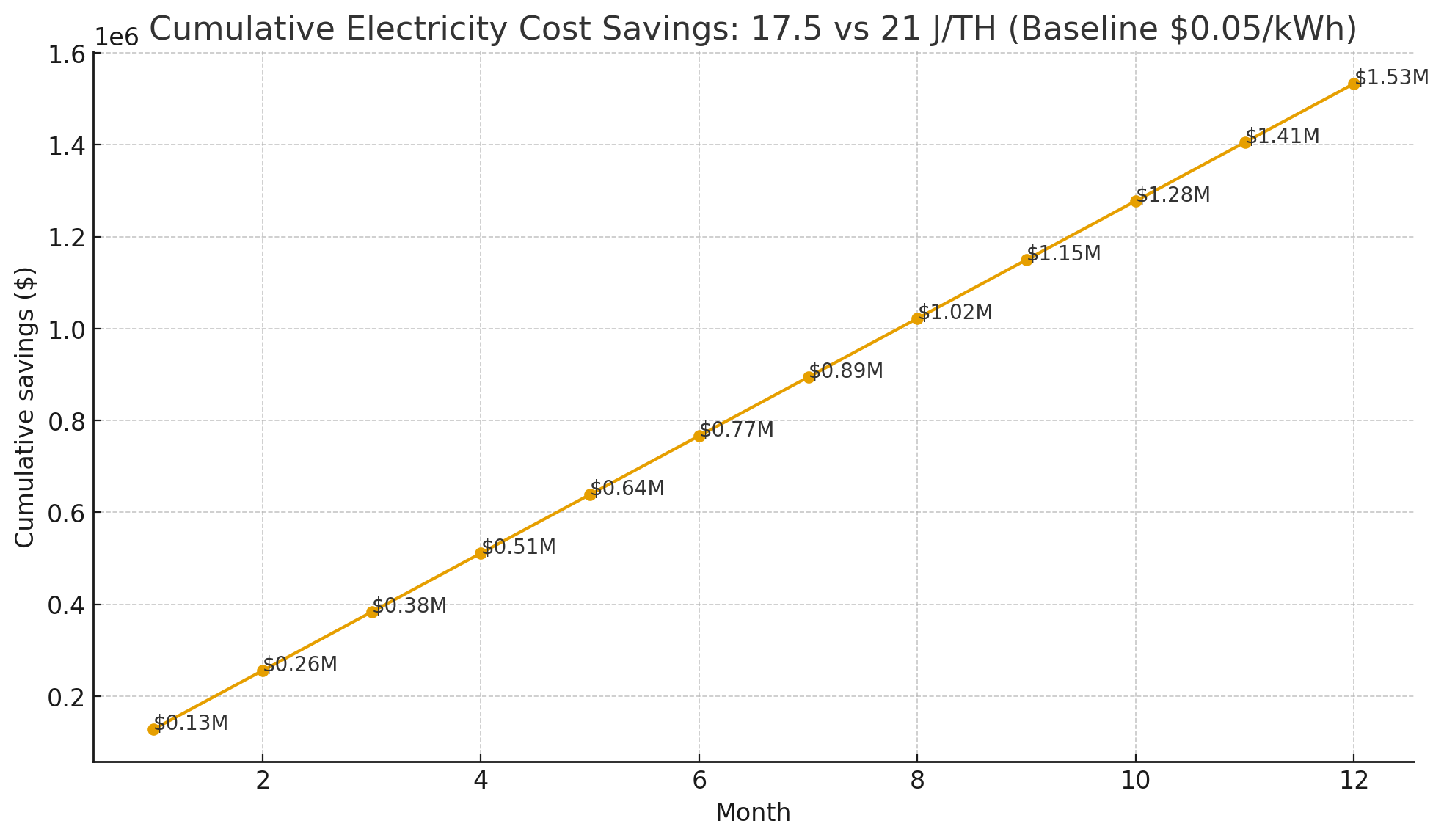
The comparison highlights the impact of small efficiency gains at scale. For a 1 EH/s fleet, moving from 21.0 J/TH to 17.5 J/TH reduces power demand by 3.5 MW, translating into annual savings of roughly $0.9M at $0.03/kWh or $1.8M at $0.06/kWh. Even modest improvements in efficiency deliver meaningful financial benefits when deployed across exahash-scale fleets. The savings not only scale linearly with hashrate but also grow more significant as power prices rise. Ultimately, efficiency gaps of just a few joules per terahash can mean millions of dollars in operating cost differences, reinforcing why hardware efficiency is a decisive competitive factor in industrial Bitcoin mining.
Breakeven BTC Price: Efficiency as a Safety Net
The breakeven Bitcoin price can be thought of as the threshold at which mining operations stop losing money. To reach this point, two moving parts come together: the cost of producing one unit of hash power and the amount of Bitcoin that unit of hash power can generate. On the cost side, electricity dominates. A machine with lower efficiency consumes less energy to perform the same work, which directly reduces the daily operating bill. On the output side, the reward depends on the network difficulty, which determines how much Bitcoin a terahash can earn each day.
In mining economics, electricity costs remain the dominant determinant of profitability, typically accounting for 60–70% of total operating expenses. Breakeven models that isolate power costs offer a clear framework for comparing fleet efficiency, even if they exclude depreciation, hosting, and maintenance. In our analysis—assuming a network difficulty of 129T, an average production rate of 0.49 BTC per EH/s per day, and varying electricity prices—the breakeven Bitcoin price scales proportionally with power costs. At an electricity rate of $0.05/kWh, a fleet operating at 17.5 J/TH achieves breakeven around $42,900 per BTC, while a less efficient fleet at 21 J/TH requires roughly $51,400. This differential illustrates how energy efficiency directly lowers the economic threshold for profitability and enhances a miner’s resilience through market volatility.
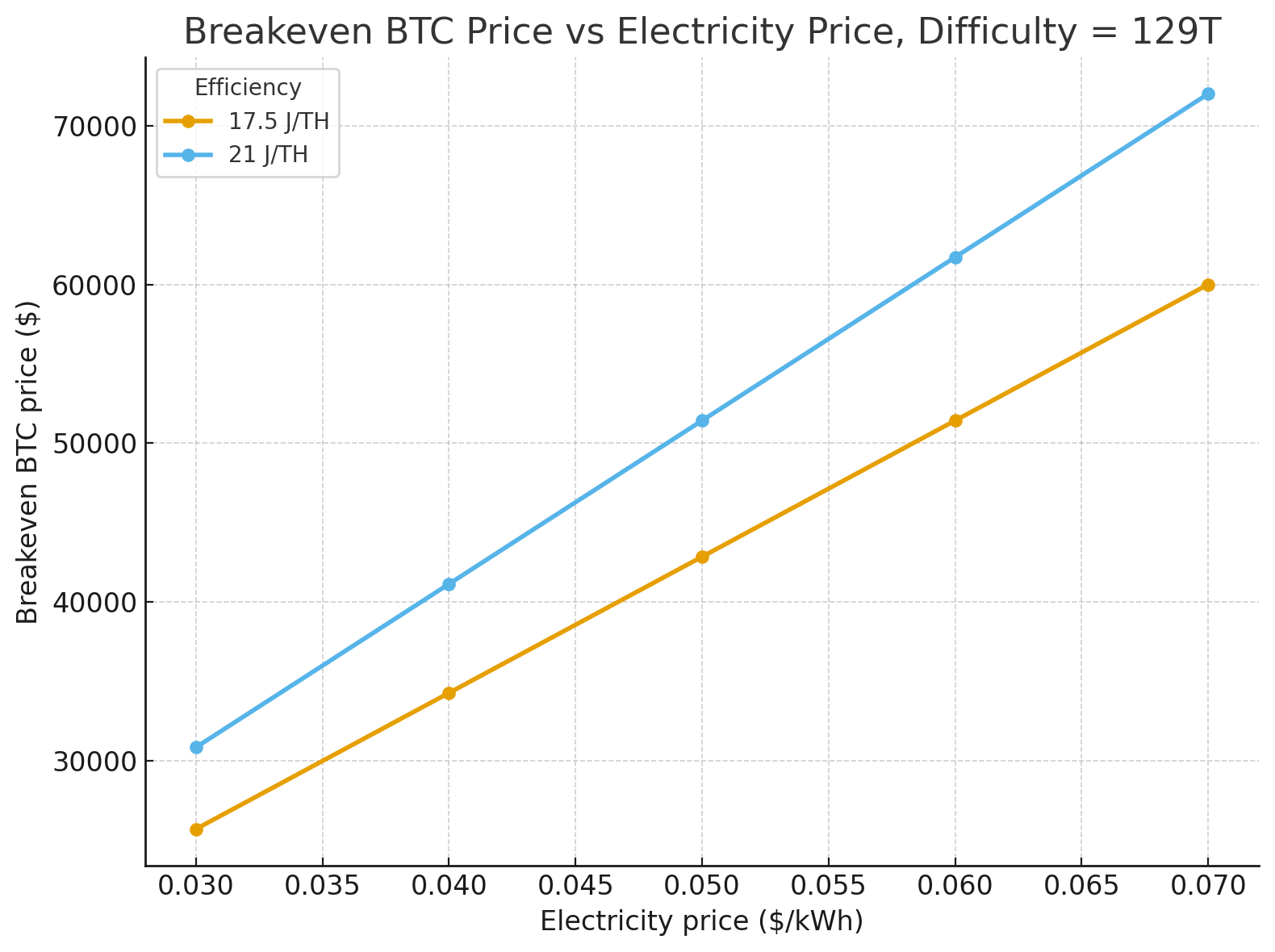
This difference highlights why efficiency functions as a safety net. In bullish markets, lower breakeven thresholds translate into wider margins. But when prices fall or difficulty rises, the less efficient machines are the first to be switched off, while the more efficient fleet continues to operate. In other words, efficiency provides miners with resilience in downturns and the flexibility to reinvest earnings when conditions improve.
Conclusion
Average fleet efficiency is not just an engineering metric—it is the fault line that separates sustainable value creation from gradual erosion. Every joule saved per terahash compounds into millions of dollars in avoided costs, which flow directly into stronger margins, healthier balance sheets, and ultimately greater shareholder value. In a sector where electricity bills decide survival, efficiency becomes the purest form of capital discipline: it preserves cash, extends fleet life, and maximizes returns on every dollar of deployed hardware. The miners who invest in superior efficiency are not only protecting today’s profitability—they are underwriting their ability to survive the next downturn and capture disproportionate upside when markets recover.
Connect with us:
Recommended

What Happens If a Mining Farm Suddenly Loses Power? Understanding BitFuFu’s Dual Hashrate Protection Mechanism
Category:Mining Guide
Author:BitFuFu
2026.05.29

Why 2026 Is a More Favorable Year for Investing in Cloud Mining
Category:Mining Guide
Author:BitFuFu
2026.05.14