According to multiple media reports, Elon Musk's space exploration technology company SpaceX will soon submit its IPO prospectus to the U.S. Securities and Exchange Commission (SEC), targeting a valuation of $1.75 trillion and expecting to raise over $75 billion. If successful, this would be the largest IPO in human history, far surpassing Saudi Aramco's 2019 record of $29.4 billion, and will be the most anticipated IPO this year.
Interestingly, in February 2026, SpaceX acquired xAI, another AI company under Musk, and incorporated "orbital data centers" into its core strategy: utilizing the vacuum environment of space for heat dissipation and continuous solar power supply to send AI computing power into low Earth orbit. Musk believes that in the long run, space-based AI is the only way to achieve scalable development.
At the same time, Nvidia is also actively pursuing this direction. It has invested in Starcloud, an orbital data center startup, which successfully sent an Nvidia H100 GPU into orbit in November 2025, completing humanity's first AI large model training and inference in space.
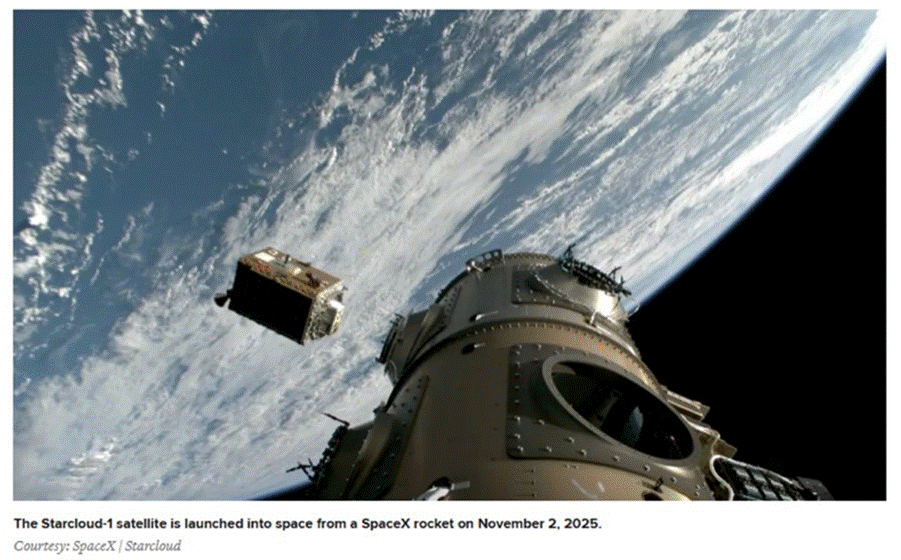
With SpaceX sending AI computing power into space, many people have begun to wonder if Bitcoin mining, which also relies on computing chips and can utilize solar energy, could also be moved to space? However, this question is far more complex than imagined.
One Satellite, One Solar Panel, One Miner
Mining is a competitive mathematical computation. Millions of miners worldwide operate simultaneously, vying to be the fastest to solve a specific hash value, with the successful one receiving Bitcoin rewards for the current block. This process is called Proof of Work, and its cost is a significant amount of electricity. The continuous power consumption of the global Bitcoin network is approximately 20 gigawatts, equivalent to the total industrial electricity consumption of a medium-sized country. The profit margin for miners is largely determined by electricity prices; once electricity prices rise, profit margins are compressed.
And the endless sunlight in space perfectly addresses the most critical cost variable in Bitcoin mining: electricity.
In Earth's orbit, solar radiation intensity is about 1380 watts/square meter, six times the average level on the ground, and is unaffected by clouds, day-night cycles, or seasons. In specific geosynchronous orbits, satellites can receive near-continuous sunlight and generate power continuously. The underlying logic of space mining is to attach miners to the back of solar panels, send them into orbit, and let them mine forever.
Bitcoin core developer Peter Todd published a technical analysis in December 2024, pushing this idea from concept to engineering blueprint. He proposed the concept of a "flat miner": ASIC chips are directly installed on the back of solar panels, with the front facing the sun to generate electricity, and the chips on the back consuming electricity for mining, with the entire structure radiating waste heat in both directions.
Space heat dissipation is a counter-intuitive challenge. On Earth, chip heat can be carried away by air convection; but in the vacuum of space, there is no air, and heat can only be radiated out. Todd's calculations show that without additional heat dissipation devices, the thermal equilibrium temperature of this structure in orbit is about 59°C, which is well within the normal operating range of the chips. If the temperature is considered too high, simply tilting the entire panel slightly relative to the sun to reduce the illuminated area can further improve heat dissipation.
Communication is also surprisingly simple. The communication between miners and mining pools essentially involves receiving new block headers and submitting calculation results, generating about 10MB of data per day, which is less than the data consumed by streaming a single song. Communication latency in low Earth orbit (500 to 1000 kilometers from Earth) is between 4 and 30 milliseconds, resulting in a stale block probability of less than 0.01%, which is on par with most ground miners and has no substantial difference. In fact, Blockstream began broadcasting the entire Bitcoin blockchain globally via geosynchronous satellites as early as 2017, proving that the combination of satellites and blockchain has never been an unsolved problem.
So, if it's physically feasible and the engineering framework is also viable, why isn't it widespread? The reason is the high cost of rocket transportation.
The Unprofitable Economics
Using SpaceX's Falcon 9 rocket to send cargo to low Earth orbit currently costs approximately $2,720 per kilogram. Peter Todd estimates that a complete 20-kilowatt space mining system, including solar panels, thermal radiators, ASIC chip arrays, structural supports, and communication modules, would weigh approximately 1,600 to 2,200 kilograms. At current prices, the cost of a single launch alone would be between $4.3 million and $6 million.
How much computing power can this system contribute daily, and how many coins can it mine? Researcher Nick Moran provides the answer: a daily profit of about $92.7, totaling approximately $34,000 per year. The payback period exceeds 100 years.
Starcloud CEO Philip Johnston has calculated that launch costs must drop below $200 per kilogram for space mining to be commercially viable. This means costs need to decrease by another 13 times.
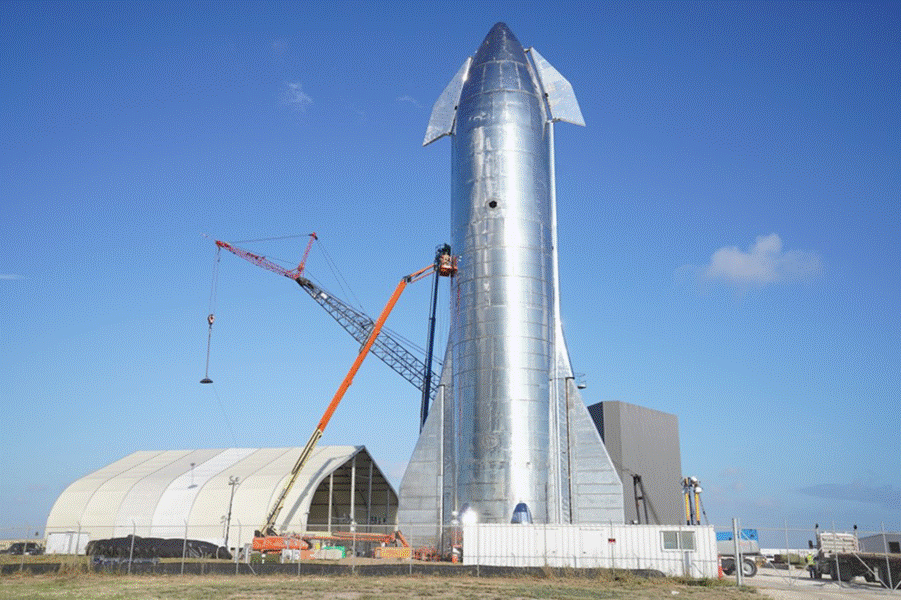
SpaceX's Starship is widely considered the key to achieving this breakthrough. The fully reusable Starship could theoretically reduce launch costs to below $100 per kilogram or even lower, which is one of the underlying assumptions for the establishment of space data centers in SpaceX's IPO vision. However, when and if this cost curve will materialize remains an open question.
Another challenge is the automatic adjustment of the Bitcoin network's mining difficulty. The Bitcoin protocol calculates the total network computing power every two weeks and automatically adjusts the mining difficulty to maintain a block generation rate of approximately one block every 10 minutes. In other words, if a large number of space miners enter the market and the total network computing power significantly increases, the mining difficulty will be adjusted upwards, compressing the profits of all miners, including those in orbit.
There are always people busy searching for treasure in this world
Despite this, a number of startups are actively pursuing this endeavor.
Starcloud, formerly Lumen Orbit, is currently the closest company to actual implementation and the most important observation sample in this field. Founded in 2024, headquartered in Redmond, Washington, it is backed by angel funds from NFX, Y Combinator, a16z, and Sequoia Capital, as well as Nvidia. The total funding raised is approximately $200 million. The company's CTO worked for Airbus Defence and Space for ten years, and its chief engineer previously led the Starlink project at SpaceX.
In November 2025, Starcloud successfully launched its first satellite carrying an Nvidia H100 GPU into orbit, running Google's Gemma language model in space and sending humanity's first AI-generated message from orbit to Earth.
In March 2026, Starcloud announced that its second satellite would carry both Bitcoin ASIC chips and Nvidia's latest-generation Blackwell GPU, aiming to become the first organization in human history to mine Bitcoin in space. Additionally, the company has applied to the U.S. Federal Communications Commission (FCC) to deploy a constellation of up to 88,000 satellites, with a long-term vision of building a total of 5 gigawatts of computing infrastructure in orbit.
SpaceChain is an OG player in this field, co-founded by former Bitcoin core developer Jeff Garzik and Zheng Zhong. Since 2017, SpaceChain has launched at least seven blockchain payloads to satellites and the International Space Station. In June 2020, Garzik completed humanity's first space Bitcoin transaction, totaling 0.0099 BTC, in orbit 400 kilometers from Earth, using SpaceChain's multi-signature wallet node installed on the space station.
SpaceChain's core focus is on orbital security nodes for blockchain transactions, rather than active mining: locking private keys in space, where no ground-based hacker or government can physically access them.
Cryptosat, founded by two Stanford PhDs, currently operates three satellites in orbit, primarily providing tamper-proof orbital cryptography services. In 2023, Cryptosat participated in Ethereum's largest trusted setup ceremony (KZG Ceremony) in history, generating some random number parameters through orbital nodes, institutionally ensuring that these parameters cannot be controlled by any single ground-based entity. What it explores is another possibility for space blockchain: not mining, but making the entire crypto-economic system more difficult to attack.
From Orbit to Market: What This Means for the Mining Industry
For currently operating Bitcoin mining enterprises, while space mining does not yet pose a practical competitive threat in the short term, a large number of startups continue to attempt it, which also indicates that the significant cost reduction potential it represents still holds great appeal and imagination for the industry. This also indirectly reflects that the entire industry is facing structural cost pressures.
After the 2024 halving, the total network computing power and difficulty continue to reach historical highs, with energy costs accounting for 70% to 90% of total operating costs. In this context, whoever can stably obtain clean electricity at the lowest cost will have the deepest moat. Hydropower, wind energy, and natural gas associated gas resources in the United States, the Middle East, and Africa are becoming the core drivers for a new round of mining mergers and acquisitions and site selection.
The logic of space mining is the ultimate extrapolation of the above trend: if cheap electricity on the ground will eventually narrow due to demand competition, then go to the most abundant energy source, which is the universe.
Of course, if the Starcloud-2 satellite successfully mines the first Bitcoin in 2026, it would be like a grain of sand falling into the ocean compared to the global total computing power of over 900 Exahashes (EH/s) per second. But the symbolic meaning itself is powerful. Just like the 0.0099 BTC space transaction in 2020, its value was not in the amount, but in proving that it is achievable.
From SpaceX's IPO narrative to Nvidia's orbital computing power deployment, and then to Starcloud's ASIC satellite plan, a clear outline is emerging: space is becoming the competitive arena for the next generation of computing infrastructure. AI computing power is leading the way, and Bitcoin computing power is closely following.
On that day, the global digital network described in Satoshi Nakamoto's white paper, connecting all corners of the Earth, can also break free from Earth and float in the universe, seeking new opportunities.
Connect with us: