How to Use the BitFuFu Mining Profit Calculator: A Complete Guide
Before starting Bitcoin mining, almost every user asks the same core questions: How much can I earn? What is the payback period? Is mining still profitable today?
Unlike simply buying and selling spot BTC, mining involves multiple variables—hashrate cost, service fees, contract duration, network difficulty, and Bitcoin price. This makes a reliable, scientific profit-estimation tool essential for every miner.
To help users evaluate potential mining returns, static output, and payback periods in a clear and intuitive way, BitFuFu provides a professional Mining Profit Calculator. This article will walk you through how to use the tool step by step, so you can understand your potential return on investment before placing an order.
Understanding the Key Inputs: What Each Field Means and Where the Data Comes From
Reference Price (BTC Price)
The reference price is one of the most important variables in static output calculations. It represents the Bitcoin price you want to use for your analysis. You can enter the current market price or a hypothetical future price for scenario testing.
This value is entered manually. Real-time BTC prices are available from major exchanges such as Binance, OKX, or Coinbase, or from data platforms such as CoinMarketCap, CoinGecko, and TradingView.
Reference Difficulty
The reference difficulty represents the current Bitcoin network mining difficulty, which determines how much BTC your hashrate can produce per day. When the difficulty increases, each terahash yields less BTC.
This value also must be entered manually. You can obtain it from blockchain explorers or mining analytics sites including BTC.com, mempool.space, CoinWarz, or Blockchain.com.
Price of Hashrate
Price of Hashrate is the base cost of cloud mining. It shows how much you need to pay per terahash per day.
You do not retrieve this value from external sites—it comes directly from the BitFuFu product page. If the S19 XP plan lists the price as 0.0063 $/T/Day, you should enter 0.0063 in the calculator.
Period of Hashrate (Mining Duration)
This field specifies how long your cloud mining contract will run. Different products may offer 14-day, 45-day, or 90-day durations. This number also comes directly from the product details page.
Initial Service Fees (Prepaid Service Fee Days)
Some cloud mining plans require you to prepay a number of service-fee days upfront. This number indicates how many days of electricity and hosting costs you must pay at the time of purchase. For example, if the plan states “Initial service fee: 10 days,” then you should enter 10 in the calculator.
Service Fee Price
Service Fee Price is the daily cost of electricity and maintenance per terahash. Since different mining facilities have different operational costs, this number is specific to each BitFuFu product. If the product lists the service fee as 0.0361 $/T/Day, simply enter 0.0361.
Quantity of Hashrate
This is the amount of hashrate you want to purchase—such as 10T, 100T, or 1000T. You can freely choose this value based on how much you intend to mine.

A Practical Walkthrough
Let’s walk through a complete example to illustrate how to fill in each field correctly.
Suppose you want to evaluate the potential profitability of an S19 XP 14-day cloud mining plan when:
- BTC price = $110,000
- Network difficulty = 150T
- Purchased hashrate = 1000T (or any amount you choose)
These values must be entered manually.
Next, visit the BitFuFu product page to gather the parameters specific to the plan:
- Price of Hashrate: 0.0063 $/T/Day
- Service Fee Price: 0.0361 $/T/Day
- Period of Hashrate: 14 days
- Initial Service Fees: typically shown as 10 or 14 days, depending on the plan
Once all data is entered, click “Calculate.”
The Mining Profit Calculator will then provide you with:
- The static breakeven period
- Total investment over the entire contract (including initial service fees)
- The static mining output
- The net static profit or loss
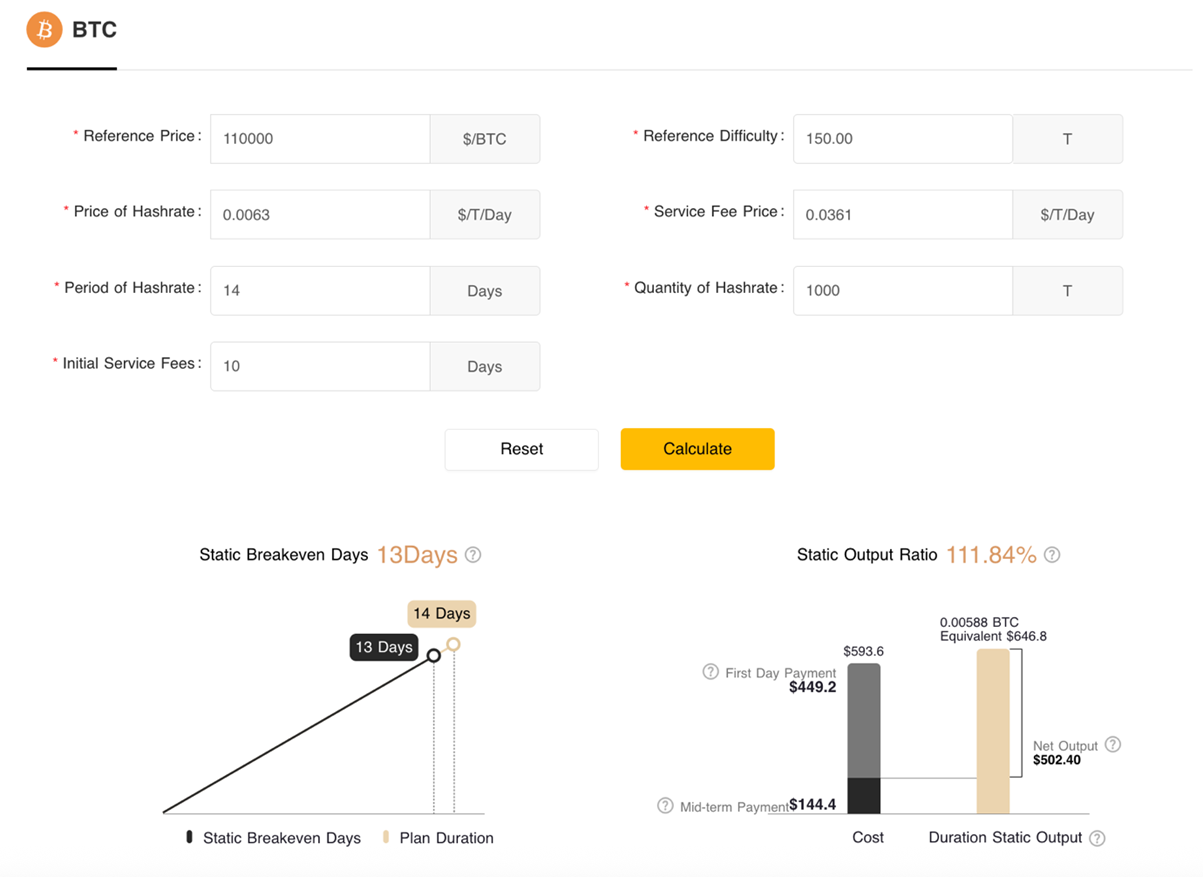
This process allows you to evaluate a mining plan under any market scenario—before making any financial commitment.
How the Calculator Computes Your Earnings: The Logic Behind Static Profitability
To help users take full control of their mining investment, the BitFuFu calculator uses transparent, verifiable industry-standard formulas.
Static mining yield is based on:
Static Mining Yield = Purchased Hashrate × Actual Mining Days × Theoretical Daily Mining Output
Theoretical daily output depends on network difficulty and the block reward, which together determine how much BTC each terahash produces in a day. Mining pools express this as “BTC per T per day.”
The calculator’s Expected Earnings take all costs into account, including the initial hashrate rental, prepaid service fees, and ongoing service fees throughout the contract.
The formula can be summarized as:
Expected Earnings = Total Mined Output (in USD) – Initial Investment – Mid-Term Service Fee Payments
The BTC-denominated yield rate (Coin Yield Rate) is calculated as:
Coin Yield Rate = (BTC Earned – BTC Equivalent of Investment) / BTC Equivalent of Investment × 100%
The calculator also uses standard profitability indicators such as:
Static Output Ratio = Net Output / First-Day Payment
Duration Static Output = Total BTC Mined × Reference Price
Static Breakeven Days = First-Day Payment / (Duration Static Output – Mid-Term Payments) × Contract Duration
Together, these formulas form the foundation of BitFuFu’s static yield model, making the profit logic clear, transparent, and reproducible.
Conclusion: Use the Calculator to Take Control of Your Mining Decisions
Mining is a long-term, data-driven investment, and mastering profit calculations is one of the most important skills for any miner. With BitFuFu’s Mining Profit Calculator, users can easily combine market variables like BTC price and difficulty with plan-specific costs such as hashrate price and service fees, simulating different scenarios to make more informed and rational decisions.
Whether you're exploring cloud mining for the first time or comparing multiple plans, spending a few minutes with the calculator before placing an order will help you build a more robust strategy and keep risks under control.
Connect with us:
Recommended

Wharton to accept tuition fee payments in Bitcoin and Ethereum
Category:マイニング情報
Author:Jessica
2021.11.03
Tesla intends to restart accepting cryptocurrency payments
Category:マイニング情報
Author:Jessica
2021.11.03