One Year After Bitcoin-Halving: Why Miners Stay Bullish and How to Remain Competitive
Disclaimer: This article is for informational purposes only and does not constitute investment advice or reflect official guidance of BitFuFu or its executives. Readers are encouraged to conduct their own research and consult with financial professionals before making any investment decisions. No copyright is claimed in the contents below and to the extent that any material may appear to be infringed, we assert that such alleged infringement is permissible under fair use principles in applicable copyright laws. If you believe any material has been used in an unauthorized manner, please contact the poster.
April 2024 marked Bitcoin’s fourth halving, cutting the block reward from 6.25 BTC to 3.125 BTC and instantly squeezing mining revenues. One year later, the global Bitcoin mining industry has weathered the halving event and remains strikingly bullish. Leading miners have adapted through innovation, scale, and strategy. Institutional investors and the mining community are now looking at a more resilient sector that continues to expand.
This article delves into data-driven insights from the post-halving year—from surging network hash rates to evolving miner economics—and highlights key strategies miners can employ to stay competitive.
Post-Halving Network Trends: Hash Rate & Revenue Surge
Bitcoin’s network fundamentals tell a story of resilience in the year after the 2024 halving. The network hash rate—the total computational power securing Bitcoin—initially saw a brief slowdown right after the halving, as some older, less efficient machines went offline. However, April 2025, the hash rate not only recovered but hit roughly 1 zettahash (1 ZH/s), a new record that was about 40% higher than pre-halving levels. Even as mining difficulty adjusted upward to all-time highs, miners continued adding capacity—a strong vote of confidence that mining remains profitable at scale.
The miner revenue data further illustrates this adaptation. After halving slashed the BTC earned per block, miners initially saw their topline fall—but a strong market rally in late 2024 offset the loss. In fact, Bitcoin mining revenues climbed to $3.7 billion in Q4 2024, a 42% jump from the prior quarter. By Q1 2025, quarterly mining revenue held at roughly $3.6 billion, virtually on par with the pre-halving period.
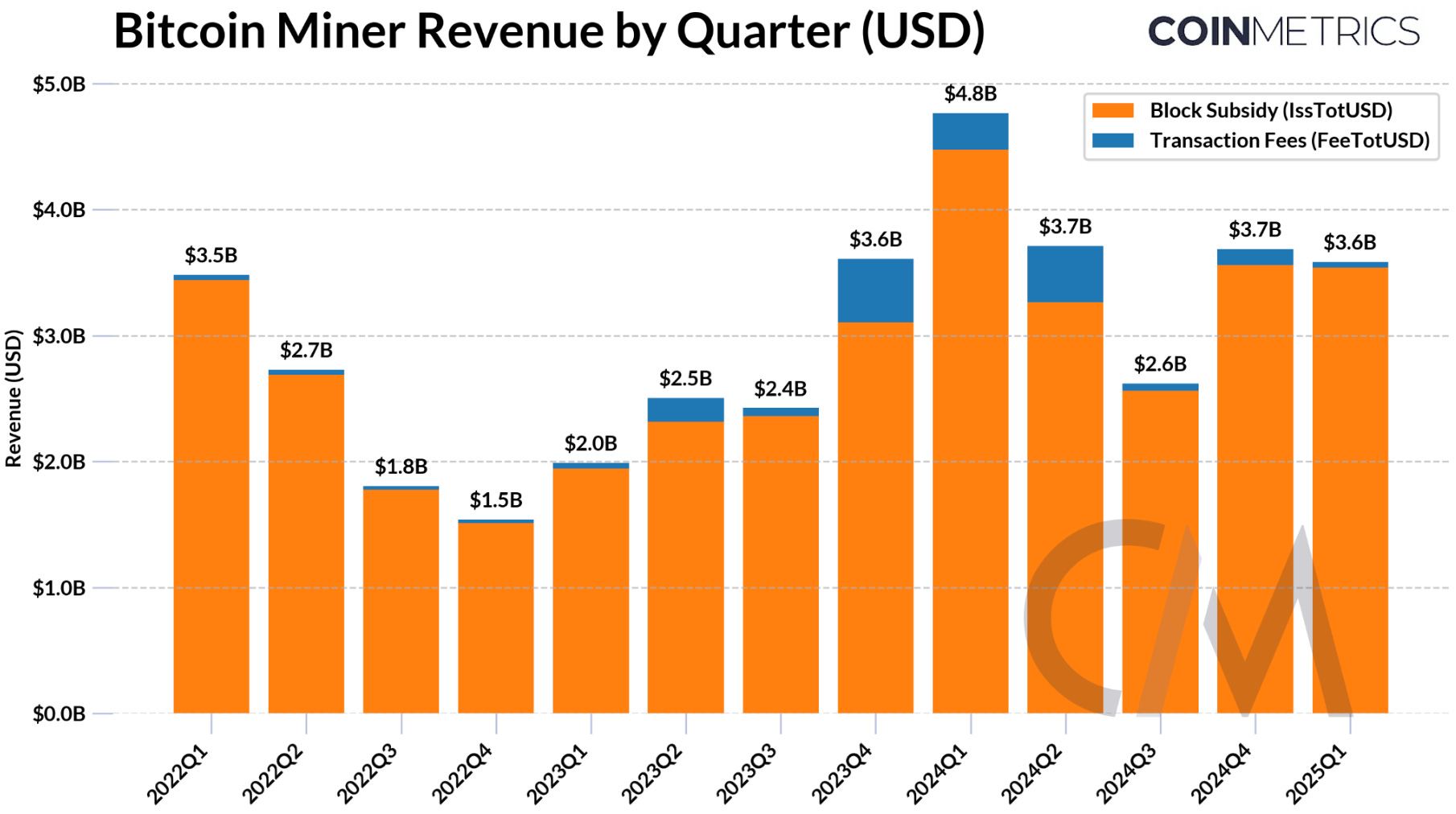 Bitcoin Miner Revenue by Quarter. Source: COINMETRICS
Beneath the revenue rebound, however, miners had to become far more efficient. A key profitability metric, hashprice, which measures daily revenue per unit of hash power, hovered around historic lows. By March 2025, hashprice had stabilized at roughly $48 per petahash per second (PH/s)—less than one-sixth of its value during the 2021 bull market. At $48/PH/s, some older mining rigs struggle to break even. Many users turned to higher-performance rigs or opted for cloud mining contracts as more viable alternatives.
Why Miners Stay Bullish Post-Halving
Despite the challenges of the halving, the global mining community remains fundamentally bullish for several reasons.
Historical Precedent: Every past halving has been followed by a major bull market in Bitcoin. Reduced supply issuance tends to drive up Bitcoin’s price over the subsequent 12–18 months. After the 2012, 2016, and 2020 halvings, Bitcoin's price surged approximately 92x, 30x, and 8x, respectively—from the halving day price to each cycle's peak. This time is proving no different—Bitcoin reached an all-time high of $109,134 in January 2025. Higher Bitcoin prices directly improve mining economics, so many miners view short-term pain as leading to long-term gain.
Rather than selling mined Bitcoin immediately, many operations adopt sophisticated treasury management strategies. By holding a portion of mined Bitcoin and selling only when necessary or at predetermined price targets, miners can maximize returns during price appreciation phases.
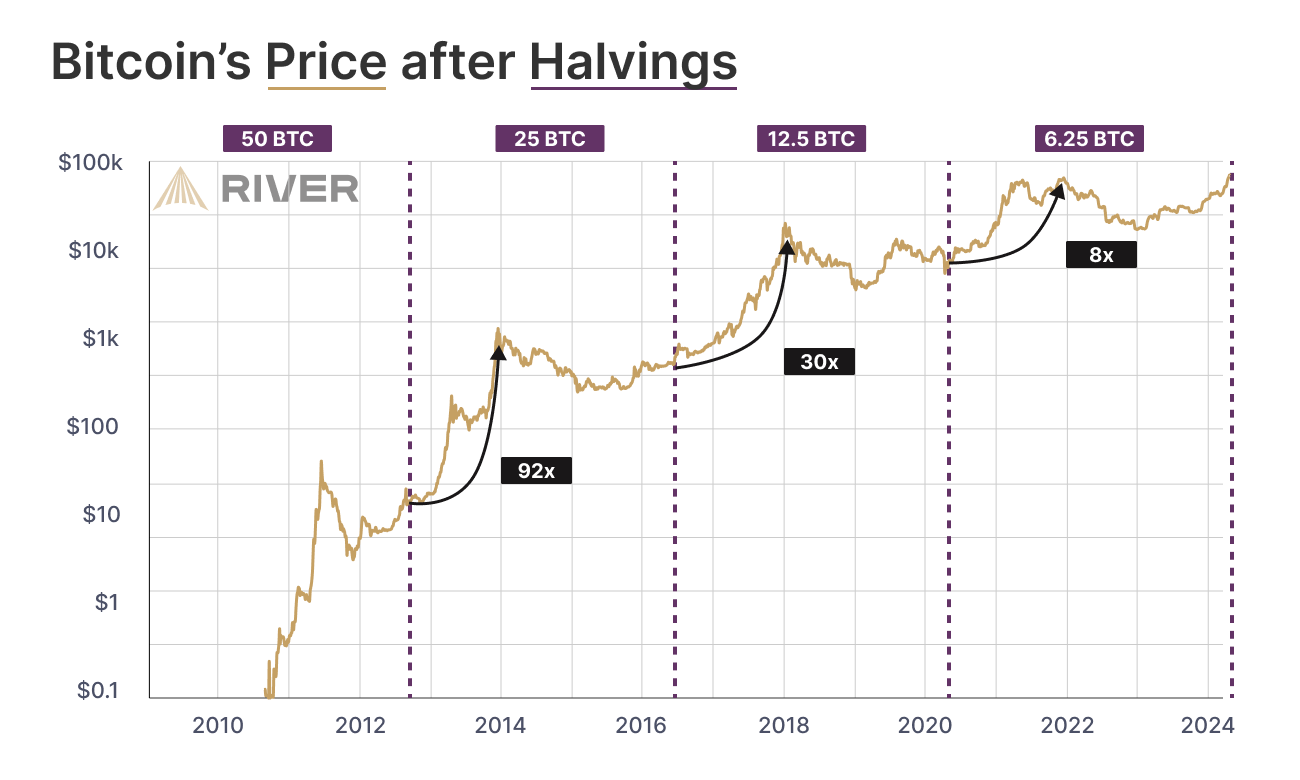 Bitcoins increases in price following each halving event. Source: River Learn.
Revenue Diversification: Today’s miners are not solely reliant on block rewards. Transaction fees, which spiked during periods of high network activity, provided a valuable additional revenue stream. Moreover, mining firms have diversified business lines. For example, BitFuFu's services span from hosting services for other miners, to cloud mining products for both institutional and retail users, and sales of mining equipment.
Technology Trajectory: Another reason why miners stay bullish is because of the relentless technological improvements and efficiency gains on the horizon. The ASIC hardware cycle continues to deliver better performance with each generation, which helps restore miner profitability over time. Early adoption of these new miners can lower the cost per Bitcoin mined, compensating for the halved reward. Mining firms are also developing proprietary firmware and optimization software to tune their rigs for maximum efficiency.
Strategies for Post-Halving Competitiveness
To thrive after a halving event, miners have had to refine their business strategies. We believe four key areas are standing out: diversifying geographically, expanding infrastructure, optimizing energy use, and deploying proprietary technologies. Below, we explore each strategy and how they contribute to maintaining an edge.
Geographic Diversification: Leading miners are spreading their operations across multiple regions and jurisdictions to capitalize on favorable conditions and hedge against local risks. Now entering 2025, geographic diversification has become one of the cornerstones of competitive mining.
Electricity price is the single largest cost input for Bitcoin mining. Different regions offer vastly different power costs—from hydroelectric dams in mountainous regions, to surplus natural gas in oil fields, to subsidized industrial rates in some countries. Successful miners establish facilities wherever power is cheapest and reliable.
Diversification isn’t just about power costs; it’s also about political and regulatory risk management. Mining-friendly jurisdictions with clear regulations and tax incentives (such as certain U.S. states, El Salvador, or Ethiopia) attract investment, whereas areas considering heavy taxes or bans are less appealing. Recently, Pakistan plans to allocate part of its surplus electricity to Bitcoin mining and AI data centres.
Infrastructure Expansion and Scale: Scale remains a decisive competitive advantage in Bitcoin mining. Larger operations benefit from economies of scale in purchasing, operations, and financing—all are crucial in a post-halving world.
One year after the halving, the leading miners collectively manage exahashes of capacity that dwarf what was online just a couple of years prior. Companies are racing to build out more data centers and install more machines to increase their share of the global hash rate. Take BitFuFu as an example. BitFuFu is now managing 20.6 EH/s of total hash rate as of March 2025 and plans to reach ~33 EH/s by the end of 2025.
It’s not just hash rate—power infrastructure is a big part of expansion. Miners measure this in megawatts (MW) of power capacity. Infrastructure expansion sets the stage for bringing online the next generation of machines and for rapid scale when market conditions are favorable. BitFuFu currently manages 478 MW of hosting capacity and plans to add 1 gigawatt (1,000 MW) of secured power capacity by 2026.
Energy Optimization and Cost Efficiency: In a post-halving world of thinner margins, energy optimization is make-or-break for miners. Electricity can account for 50-70% of a miner’s direct operating costs, so securing cheap, stable power and using it efficiently is important. Top miners have struck deals or built facilities in areas with extremely low electricity rates—often $0.02–$0.04 per kWh range, which is significantly below global industrial power averages.
Miners have ventured to energy-rich locales: natural gas flaring sites in Texas and North Dakota, hydroelectric dam regions in Canada, Siberia, or Africa, and even solar/wind farms with excess generation. An important subset of the low-cost power hunt is the use of renewable energy, which often is not only cleaner but cheaper when in surplus. For example, BitFuFu’s operation in Ethiopia uses 80 MW of hydropower to drive mining rigs. Similarly, wind farms in West Texas or solar farms in the Middle East have partnered with miners to monetize energy that might otherwise be curtailed during off-peak times. By integrating with renewables, miners also improve their environmental profile by reducing carbon footprint.
Cooling efficiency improvements, such as immersion cooling, also fall under energy optimization, since cooler machines run more efficiently and face less downtime.
Technology and Innovation: Continuous technology innovation is another pillar of miners’ competitiveness. From hardware to software, the mining sector post-halving is more high-tech than ever, as companies seek any edge to improve performance and reduce costs.
Bitcoin mining is ultimately an equipment race. The most straightforward way to increase efficiency is through better mining rigs. In late 2024, BITMAIN and other manufacturers rolled out new models (the Antminer S21 series, WhatsMiner M60 series, etc.) that offered substantial jumps in hash rate and efficiency. The Antminer S21 XP, for instance, deliver significantly higher terahash output per watt than the previous S19 generation—270 TH/s with 13.5 J/TH efficiency.
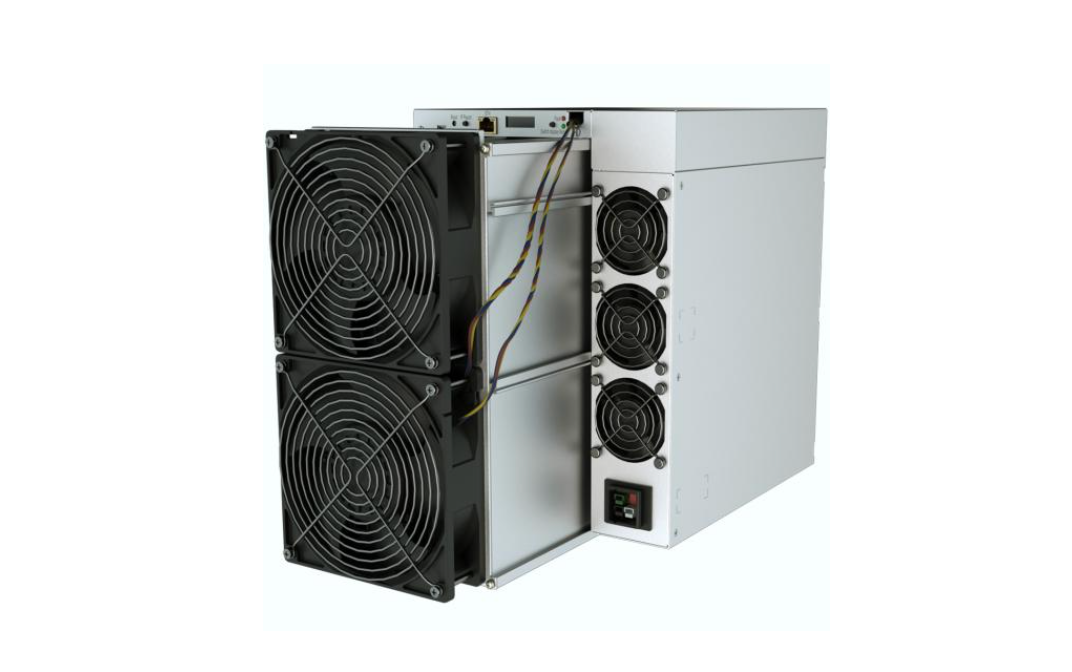 ANTMINER S21 XP. Source: BITMAIN
Many large miners also develop custom software featuring dynamic frequency/voltage scaling, better fan controls, and auto-tuning of ASICs for either efficiency or output. BitFuFuOS, a mining operating system and management software, can boost mining earnings by up to 20% through intelligent optimizations. It offers both overclocking and underclocking modes, allowing miners to dial up performance when power is cheap or scale back to save energy during high-cost periods.
Mining pools—the services that aggregate miners’ hash power and distribute rewards—are also innovating to improve miners’ yields. BitFuFuPool, a proprietary mining pool with low commission fees, gives users and self-mining operations better returns. Additionally, mining pools are optimizing their infrastructure to reduce latency implementing features like smart job assignments to minimize stale shares. Some pools even add MEV-like strategies for Bitcoin’s transaction selection, including high-value transactions or ordinals efficiently, to boost rewards.
A brief note on diversification through technology—a few mining firms have explored using their computing infrastructure for alternate workloads like High-Performance Computing (HPC) or AI training during times when mining is less profitable. This was partly in response to the halving; for instance, some miners with GPU fleets from Ethereum mining days repurposed them for AI, and others considered using ASIC data centers for AI tasks. While Bitcoin ASICs can’t do general computing, the facilities could potentially host other hardware. A number of miners have ventured into offering HPC services alongside mining. However, as of early 2025, these efforts are still nascent. Nonetheless, it reflects the mindset of miners to remain flexible and open to technological shifts, ensuring they can extract value from their infrastructure in any market climate.
Conclusion: Mining Industry Outlook One Year Post-Halving
One year after the 2024 Bitcoin halving, the data and developments paint a clear picture: the mining industry is dynamic and undeterred. Network hash power is at record highs, mining farms are bigger and more efficient, and the sector’s optimism is underpinned by concrete improvements in operations. Miners have proven they can do more with less—less reward per block, but through ingenuity and investment, not less total reward overall. By cutting costs, upgrading technology, and innovating business models, miners offset the halving impact and even tightened their grip on the network.
Recommended

What are Bitcoin improvement proposals (BIPs), and how do they work?
Category:Informationen zum Bergbau
Author:Media
2022.06.13

Wharton to accept tuition fee payments in Bitcoin and Ethereum
Category:Informationen zum Bergbau
Author:Jessica
2021.11.03